LARGE CABIN AVAILABILITY AND MARKET TRENDS

LARGE CABIN AIRCRAFT MARKET – Q3 2026
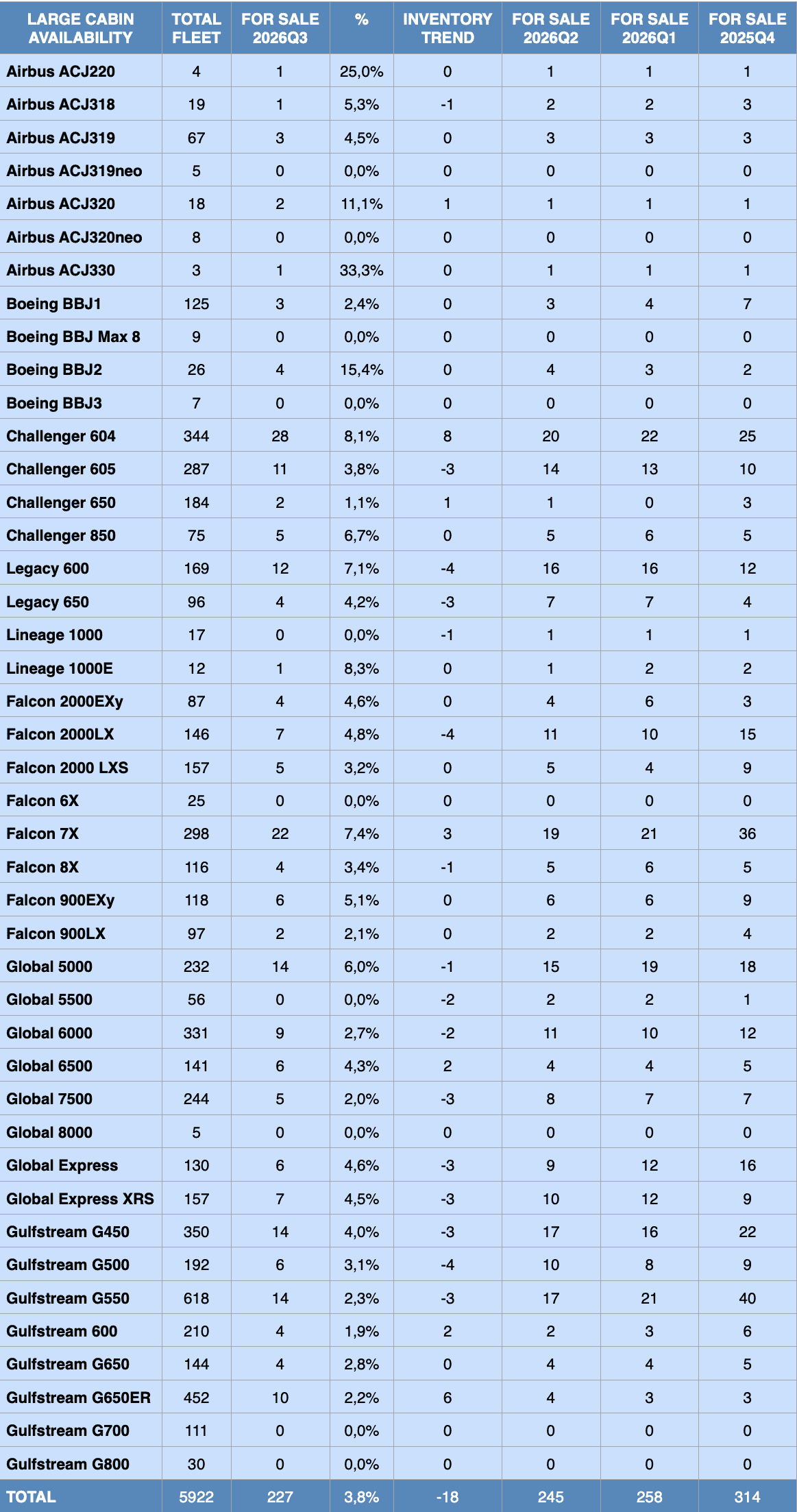
Inventory levels of large cabin aircraft officially offered for sale continue to decline. As of Q3 2026, 227 aircraft, representing only 3.8% of the worldwide large cabin fleet of 5,922 aircraft, are officially for sale. This compares with 245 aircraft in Q2, 258 aircraft in Q1 and 314 aircraft at the end of 2025.
The reduction from 314 to 227 aircraft since the end of 2025 represents a 28% decrease in available inventory and confirms a clear tightening of supply. Overall market activity remains positive.
MARKET CONDITIONS
The gradual market correction following the exceptional post-Covid boom largely concluded during 2025. The market moved from an unusually strong seller’s market towards a buyer’s market and is now becoming more balanced internationally. In the United States, tightening inventory and sustained demand are again creating seller’s-market conditions, particularly for desirable late-model aircraft.
Trade restrictions affecting pre-owned Bombardier aircraft sold into the United States have now been removed, following the earlier removal of restrictions affecting Airbus and Dassault Falcon aircraft. The removal of these restrictions is positive for transaction activity, liquidity and aircraft values in the important US market.
Interest rates are trending lower, while private aviation utilisation remains high. In the United States, continued 100% bonus depreciation provides an additional incentive for aircraft acquisitions.
AVAILABILITY BY MANUFACTURER AND MODEL
The overall 3.8% inventory level masks significant differences between manufacturers, models and generations of aircraft. Availability is particularly tight among many of the most desirable current and late-model large cabin aircraft.
Bombardier availability continues to tighten across much of the Global family. The Global 7500 stands out with only five aircraft officially for sale, representing 2.0% of the worldwide fleet. Global 6000 availability is also low at 2.7%, while the older Global Express and Global Express XRS fleets are closer to the overall market at 4.6% and 4.5% respectively. Challenger availability is more mixed, with the Challenger 650 exceptionally tight at 1.1%, while the older Challenger 604 has considerably higher availability at 8.1%.
Gulfstream inventory is particularly tight among newer and higher-value models. G600 availability is only 1.9%, G650ER 2.2%, G550 2.3% and G650 2.8%. There are currently no G700 aircraft officially offered for sale. Even the mature G450 market has tightened, with 14 aircraft currently available compared with 22 at the end of 2025.
Dassault Falcon shows a more differentiated picture. Falcon 8X availability remains low at 3.4% and there are currently no Falcon 6X aircraft officially offered for sale. Older Falcon models vary considerably, ranging from only 2.1% availability for the Falcon 900LX to 7.4% for the Falcon 7X.
Airbus and Boeing Business Jets represent considerably smaller and more specialised fleets, meaning that individual aircraft entering or leaving the market can materially affect percentage availability. The mature BBJ1 fleet nevertheless remains tight, with only three aircraft, or 2.4% of the fleet, currently offered for sale compared with seven at the end of 2025. Availability among other Airbus and Boeing VIP models remains highly model-specific.
The model-level data therefore reinforces the broader market trend: scarcity is increasingly concentrated among current-generation and desirable late-model aircraft, while availability remains higher among selected older-generation fleets.
MARKET OUTLOOK
Overall large cabin inventory remains at a low level compared with the pre-Covid years. Continued strong demand for private aviation, declining available inventory and a shortage of desirable late-model aircraft should continue to support aircraft values.
At the same time, the market is increasingly differentiated. Aircraft age, configuration, maintenance status, pedigree and programme coverage have become important determinants of both value and transaction time. High-quality, late-model aircraft with attractive specifications can command strong pricing and sell quickly, while older or less desirable aircraft may require greater price flexibility.
With continued high private jet utilisation, lower interest rates, 100% US bonus depreciation and tightening availability, we expect values of well-positioned large cabin aircraft to remain broadly stable, with continued upward pressure on selected late-model aircraft where supply is particularly constrained.